Category

Culture

The best indie bookshops you can’t miss in Lisbon

By Culture No Comments

You know that feeling of walking into a place and, without quite knowing why, realising you could stay there all afternoon? For me, that happens in bookshops. Not the massive chains with endless queues and weak coffee. I mean the small, independent ones, where the books are handpicked and the atmosphere is a mix of silence and discovery.

Luckily, Lisbon has plenty of those. Places where you go in for a book and leave with a notebook, a conversation, maybe even an invitation to a launch. Here’s my personal map of seven independent bookshops that are far more than retail spaces: they’re pieces of the city with character, where literature collides with everyday life in unexpected ways.


1. Salted Books – English literature with a Lisbon accent

📍 Calçada Marquês de Abrantes 96, Santos

Salted Books feels like it came straight out of a dream. Owned by English writer Alex Holder, who swapped London for Lisbon and brought her cool, creative, very literary friends with her, it’s a place where English-language books sparkle a little brighter. And not just that: events, conversations, launches, and spontaneous gatherings pop up here as if scripted for an indie film.

The selection is modern and eclectic – plenty of contemporary fiction, illustrated books, and poetry I’d never seen anywhere else. There’s a communal table that invites slow reading, plus homemade cakes and tea. Ask Alex (or whoever’s around) what they’re reading — it’s almost impossible to leave without a new obsession.


2. Fable – Coffee, books and creativity in São Bento

📍 Rua dos Prazeres 10A, São Bento

Fable could easily be in Berlin or Copenhagen, but it’s tucked into one of Lisbon’s loveliest neighbourhoods: São Bento. I went for the books, stayed for the focaccia. Here, literature and food go hand in hand with design, indie magazines, and natural wines.

Fun fact: it’s where I host my monthly creativity book club. The little patio out back is a perfect hideout for introverted readers. Drop me a line if you’d like to join us — I promise you’ll leave with at least one new idea.


3. Palavra de Viajante – For those who can’t sit still (not even in books)

📍 Rua de São Bento 30, São Bento

I’m not sure if I found this bookshop or if it found me. Dedicated to travel literature, it’s full of guides, diaries, essays, and maps that pull you elsewhere. Every visit plants a new destination in my head (and adds more titles to my never-ending TBR list).

It’s the sort of place where daydreaming is encouraged, even if the backpack you’re packing is imaginary.


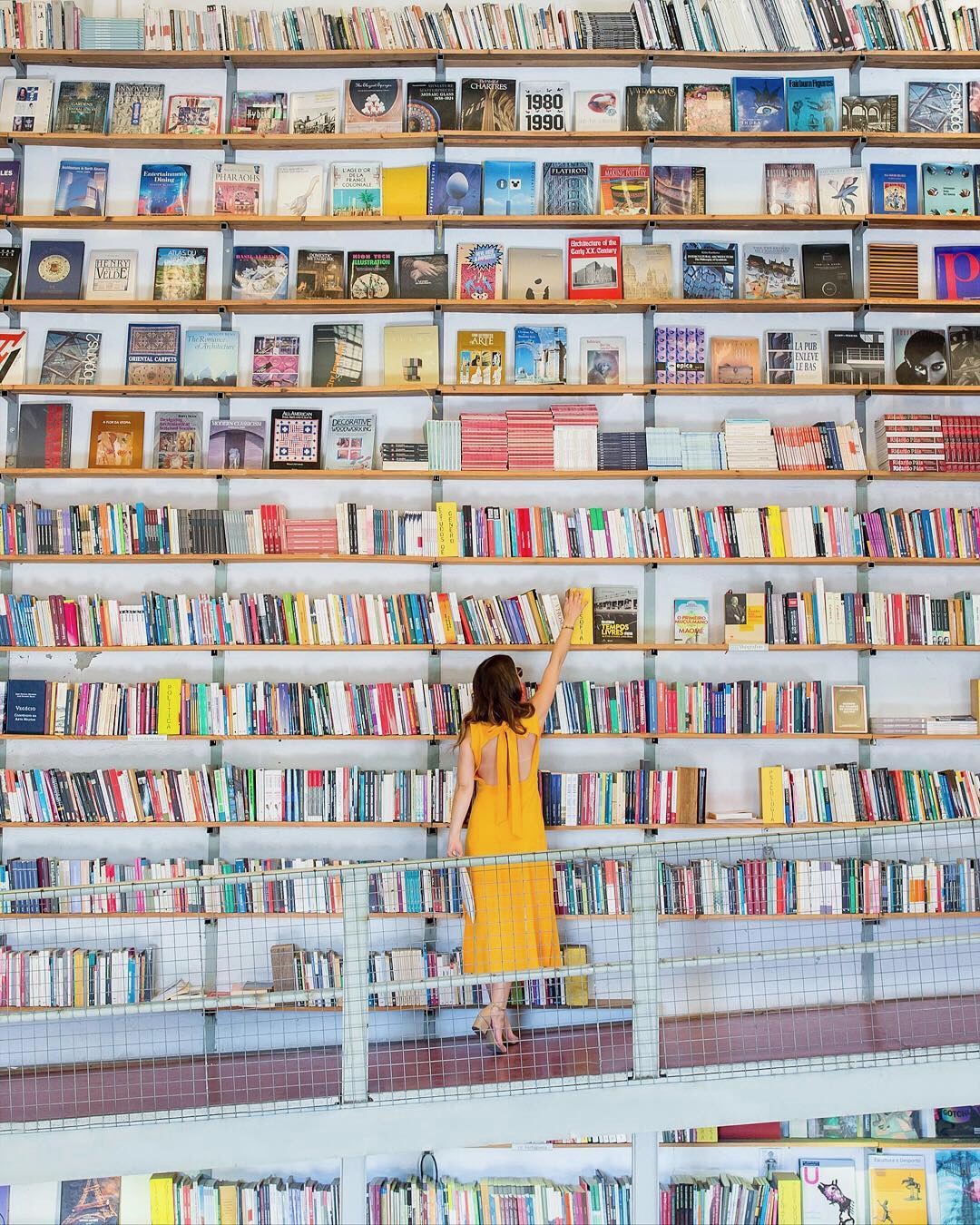
4. Ler Devagar – A cathedral for readers (and curious tourists)

📍 LX Factory, Rua Rodrigues de Faria 103, Alcântara

Yes, it’s photogenic. Yes, it’s been on every list. But Ler Devagar is still one of my favourites. It has it all: coffee, exhibitions, indie publishers, Nobel winners, and tucked-away poetry.

I like to wander in without a plan. Climb up to the mezzanine, sit with a random book, browse the quiet shelves. I’ve bought everything here, from novels to essays that shifted my perspective. It’s not just a bookshop. It’s an experience.


5. Tigre de Papel – A place where words carry intent

📍 Rua de Arroios 25, Arroios

Tigre de Papel doesn’t try to please everyone — and that’s exactly the point. It specialises in critical thought, literature that provokes, books that want to change something in whoever reads them. I walked in out of curiosity, stayed for the challenge.

They host launches, debates, and discussions that go beyond events — they’re exercises in citizenship. Here I discovered feminist authors, translators I admire, and books I’d never have found anywhere else. It’s a manifesto disguised as a bookshop.


6. Piena – Made in Italy works out every time

📍 new address


Why we need these bookshops

In a world where you can buy anything with two clicks, these bookshops remind us that books aren’t just products. They’re conversation starters, keys to other worlds, clues to who we are. Each of these seven spots has its own perspective, its own curation, its own way of resisting the rush.

When I think of the best version of Lisbon, I think of these places. And I’m grateful to live in a city where you can still leave the house without knowing what you’ll read, and come back with a book, an idea, and a new appetite for life.
Blog - Stealing like an artist | Yellow Creative Studio

The art of stealing like an artist

By Culture One Comment

Great artists don’t copy, they steal.

It’s been attributed to Picasso (or was it T. S. Eliot? Or maybe Steve Jobs quoting them both?), either way, this sentence stuck with me ever since I’ve heard it for the first time, maybe a decade ago.

But what does it really mean to “steal like an artist”? And where do we draw the line between inspiration and plagiarism in creative work?

The myth of absolute originality

Let’s start by admitting something uncomfortable: pure originality is almost impossible.
Bad news for anyone who believes they’re entirely original. You’re probably not. And neither am I.

Our brains are constantly processing outside input, and inevitably, those influences combine to form what we later call “original ideas.” We’re essentially cognitive DJs, remixing everything we take in.

I once had a creative writing teacher who said: “There are only seven stories in the world, and we’re forever retelling them in different ways.” At the time I thought it was a cynical exaggeration. These days, I see the truth in it. The real question isn’t whether we’re influenced — it’s how we transform those influences into something with our own stamp on it.

As Austin Kleon puts it in Steal Like an Artist (yes, I borrowed the title of this article from him — intentionally and with full respect): “Nothing is original. So embrace influence, collect ideas, and mash them up with your own personality.”

Good theft vs bad theft

There’s a crucial difference between what I call transformative theft and plain old nicking someone else’s work. I see this all the time in content projects and marketing strategies I create for clients.

The bad thief:

  • Copies outright without changing a thing

  • Doesn’t understand the context of their references

  • Hides their sources of inspiration

  • Adds nothing new

The good thief:

  • Digs deep into multiple references

  • Understands the principles underneath

  • Openly acknowledges their influences

  • Transforms and recombines to create something fresh

Back in my corporate days, I’d often see “bad theft”: campaigns that were carbon copies of each other, with zero creative spark. The interesting ones, though, proudly showed their lineage of influences — but added a surprising, fresh perspective of their own.

My curiosity cabinet: a system for stealing well

Over the years, I’ve built what I affectionately call my “curiosity cabinet.” It’s essentially a personal library of ideas, techniques and inspirations that I collect meticulously. I use a mix of Milanote, MyMind and Notion to categorise everything (yes, I know, I should consolidate it all in one place — that’s on my to-do list this year):

  • Writing techniques: narrative structures, wordplay, stylistic devices

  • Visual strategies: composition, colour palettes, typefaces

  • Voices and tones: examples of communication that resonate

  • Conceptual ideas: philosophical approaches and mental frameworks

This isn’t just a passive archive. It’s an active transformation tool. When I start a new project, I dive in, combine and remix. The outcome is never a straight copy — it carries the DNA of my influences, but in a wholly new arrangement.

And just as important: I deliberately practise attribution. When an idea comes from a clear source, I acknowledge it. Not just out of ethics, but as a way of showing I’m part of a larger creative lineage.

Cultural appropriation: theft that shouldn’t happen

Of course, there are kinds of “theft” that are problematic and unethical. Cultural appropriation is one: lifting significant cultural elements, stripping them of context, or commercialising them without respect for their meaning.

As a creative, I make a conscious effort to research and understand the cultural background of what inspires me — to ask whether my adaptation honours or diminishes the original, and to seek out voices from that culture when it’s appropriate.

This isn’t about restricting creativity. It’s about enriching it with respect and awareness.

Building your own “museum of influences”

If you want to get better at stealing like an artist, here are a few practices that have helped me:

  • Keep an inspiration journal. Note down ideas, quotes, techniques that strike you — with sources. It can be a notebook or digital tools like Notion or Evernote.

  • Study deeply, not superficially. Don’t just look at the surface of the work you admire. Try to understand the choices, context, and techniques underneath — like breaking down a recipe to see why it works.

  • Mix unlikely influences. Some of the freshest ideas come from cross-pollination. What happens when you apply architectural principles to writing? Or culinary concepts to graphic design?

  • Practise deliberate remixing. Consciously select elements from different references and challenge yourself to combine them into something new — like a chef experimenting with unexpected fusions.

  • Be transparent about your influences. Crediting your sources doesn’t diminish your creativity. It shows erudition and honesty. It signals confidence, not insecurity.

From the anxiety of influence to the joy of transformation

The poet Harold Bloom wrote about the “anxiety of influence” — the fear that creators are doomed to remain shadows of the giants who came before them. But maybe it’s time to reframe that anxiety into celebration.

We’re all part of a vast creative conversation that stretches across time and space. Each contribution is both an echo and a new voice. When we embrace our influences and transform them with intention, honesty and respect, we’re not just “stealing like artists.”

We’re taking part in the grand dialogue of human creativity.

So tell me: what are your main influences? How do you transform them in your work? I’d love to hear how you steal creatively.